Travel journal · November 2024
JAPAN II
Fifteen days, from 9 to 23 November 2024. From Tokyo to Osaka along the Tōkaidō, then Minoh, Nara and Kyoto before heading back to Tokyo: a single 35 mm lens, two camera bodies, and the urge to look slowly at a country that moves fast.
- Duration
- 15 days
- Route
- Tokyo → Osaka → Nara → Kyoto
- Lens
- Sigma 35 mm ƒ/1.4 Art
- Bodies
- Canon 6D · 5D Mark IV
- Reading
- 8 min
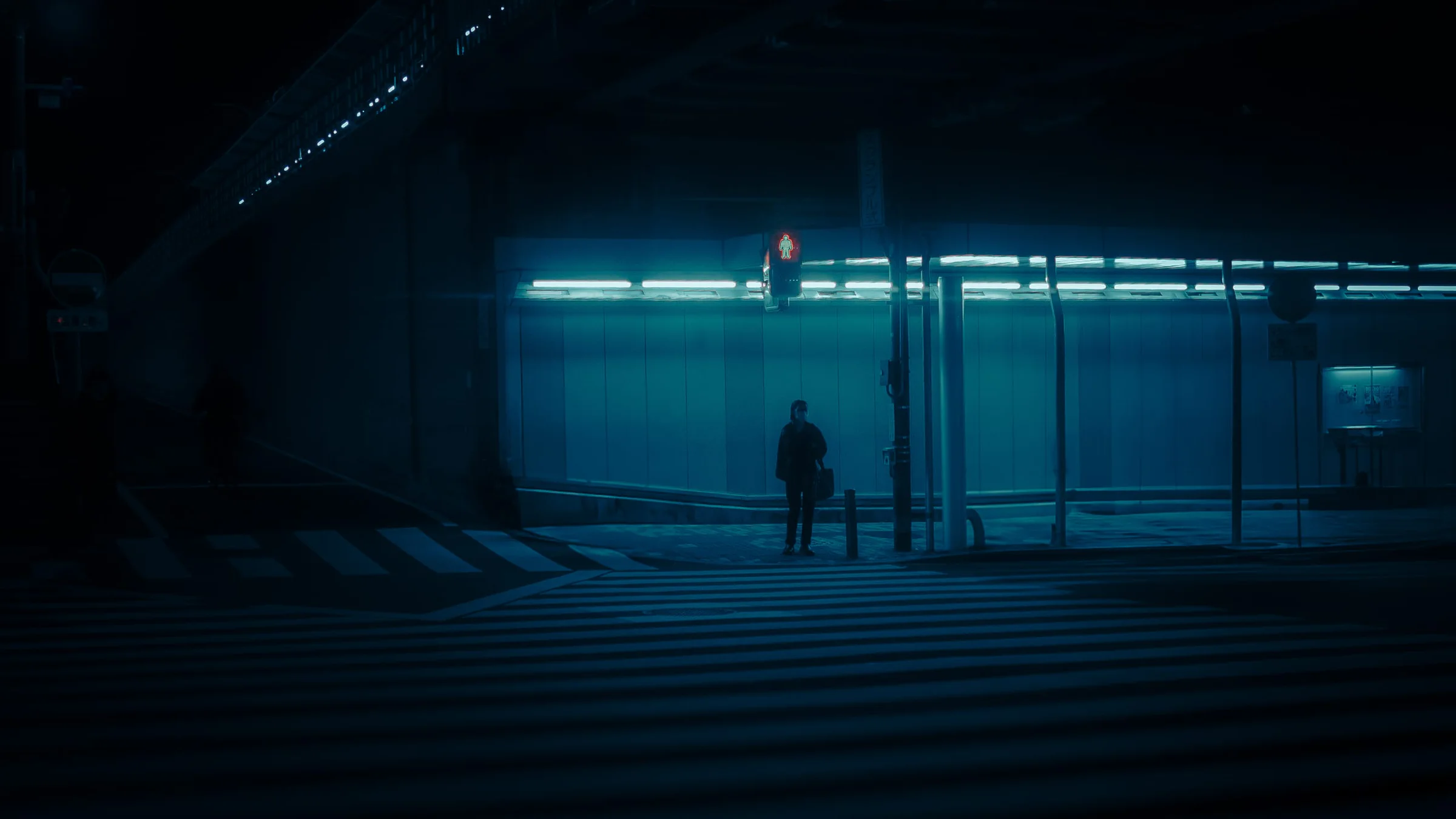
It is late, somewhere in Tokyo. A pedestrian light stays red over an empty crossing, and a figure waits under the blue neon of a construction wall. Nobody crosses: here, you wait for green even when nothing is coming.
I chose to open this journal with that image because it sets the tone. Japan teaches you to wait: for the right light, the right passer-by, the split second when the city stands still.
Chapter 01 / 06
Tokyo 東京 · Tōkyō
Fourteen million people, and a seventh-century temple two streets away from giant screens. Tokyo never chooses between old and new: it layers them.
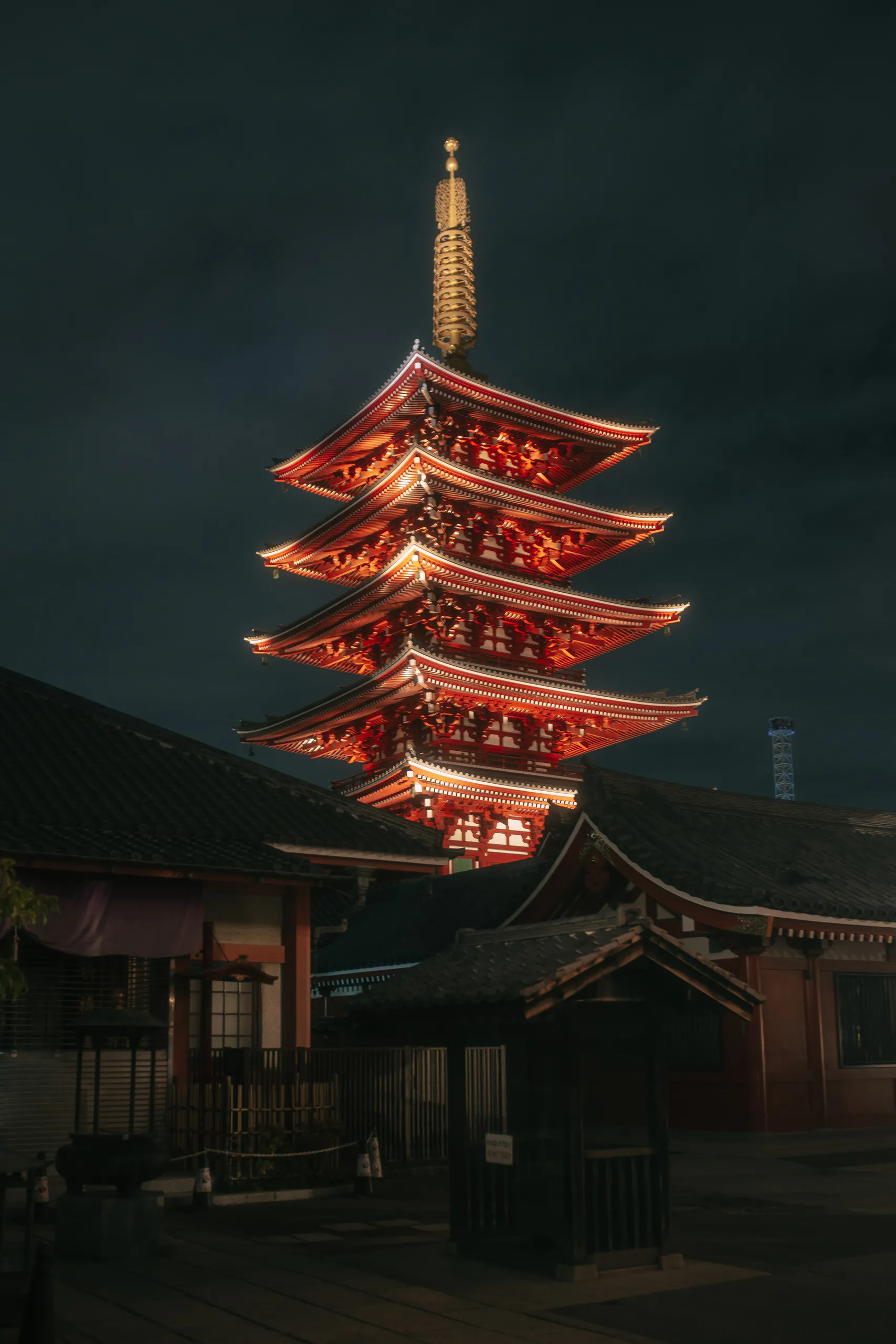
Asakusa, the first evening. Sensō-ji is Tokyo’s oldest temple: tradition dates it to 628, when two fishermen are said to have pulled a statuette of Kannon from the river in their nets. After dark the daytime crowds are gone; only the lights remain.
相輪 · sōrin
At the very top, the sōrin: the bronze spire crowning the pagoda. It is also called kurin, “the nine rings”, after the stacked discs that stand for the Buddhist heavens.
五重塔 · gojū-no-tō
Five roofs for five elements: earth, water, fire, wind and void. The current pagoda dates from 1973; the original burned in the bombings of March 1945. It rises 53 metres and holds, at its top, relics of the Buddha given by a temple in Sri Lanka.
夜 · yoru
Below, the side halls are already closed. 1/5 s handheld, ISO 640: at ƒ/2.8, the 35 mm keeps the eaves sharp without pushing the sensitivity, and the night keeps its depth.

A few steps from the temple, the smell changes: grilled skewers, beer, charcoal smoke. In the alleys of Asakusa the izakaya spill out onto the pavement; people eat on low stools under red lanterns, elbow to elbow with strangers.
The vertical sign reads 大勝 — taishō, “great victory”. I did not know it yet, but that character, 勝, would find me again six days later, in Minoh.
A change of scale. Shibuya is Tokyo’s other face: screens, signs and the most photographed crossing in the world. At every green light, up to three thousand people cross at once, in every direction, without ever bumping into each other.
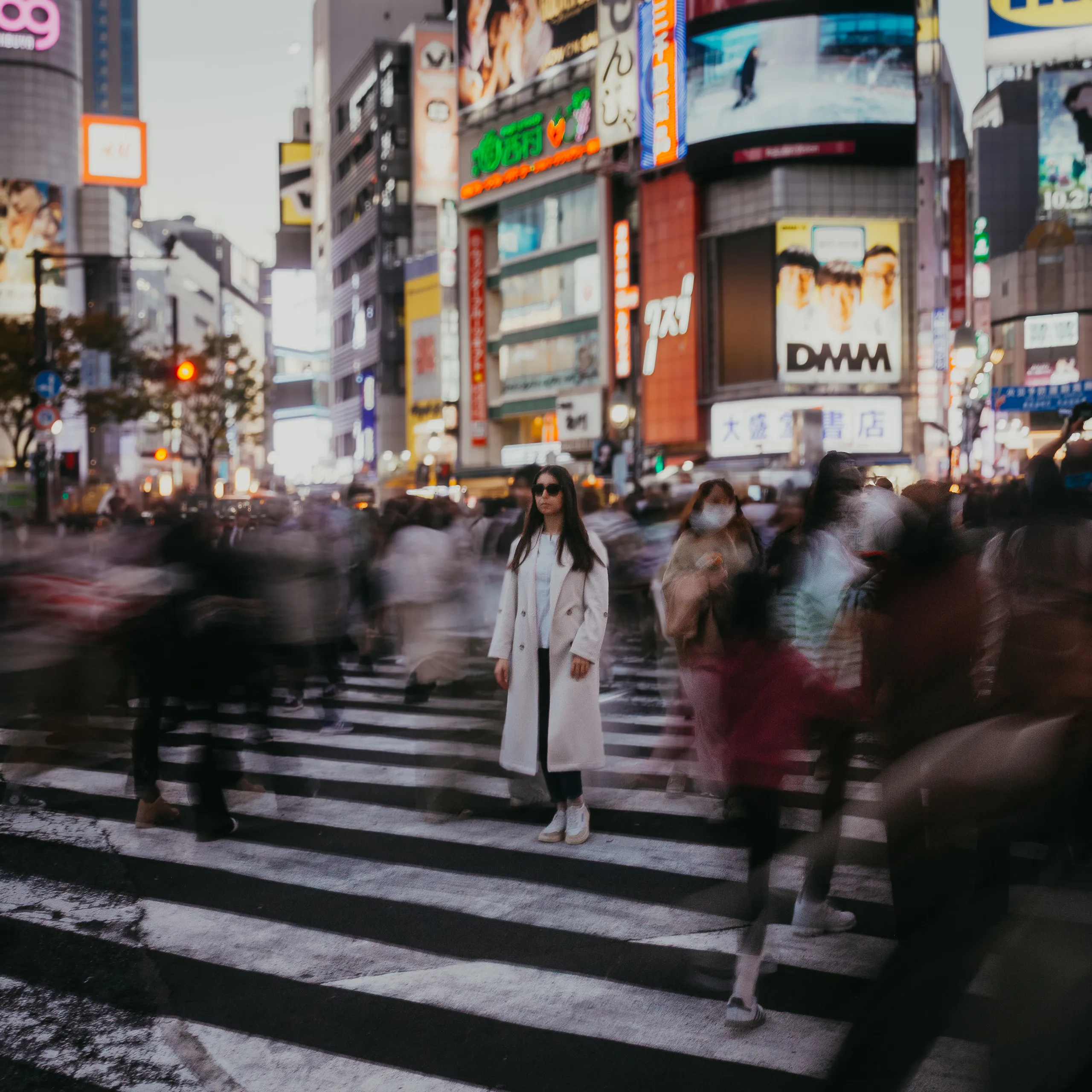
To photograph that flow, I had to slow it down. Stopped down to ƒ/10 at ISO 100, the shutter stays open for 0.6 seconds: long enough for the crowd to become a current, not long enough for it to vanish.
静 · sei
In the middle, one person standing still. Holding perfectly still for 0.6 seconds while a crowd brushes past takes more focus than it seems. She is what gives the movement around her its scale.
看板 · kanban
Above, giant screens and signs form a wall of light. In Shibuya, advertising is architecture in its own right: you barely see the façades any more.
横断歩道 · ōdan hodō
And underfoot, the white stripes. The “scramble” stops every car at once: for a few dozen seconds, the street belongs entirely to pedestrians.
 Pl. 04 · 11.11.2024 · Canon 6D · 35 mm ƒ/1.4 Art · ƒ/2.8 · 1/60 s · ISO 100
 Pl. 05 · 11.11.2024 · Canon 6D · 35 mm ƒ/1.4 Art · ƒ/2.8 · 1/400 s · ISO 100
From above, a nearby crossing draws a perfect geometry that passers-by fill without disturbing it. At the foot of the apartment towers, a small vermilion shrine, watched over by a guard: in Tokyo, the sacred sometimes fits in a few square metres.
Chapter 02 / 06
The Tōkaidō 東海道 · Tōkaidō
The “Eastern Sea Road” linked Edo to Kyoto; Hiroshige painted its fifty-three stations. Today the shinkansen runs along it at 285 km/h and takes us all the way to Osaka.
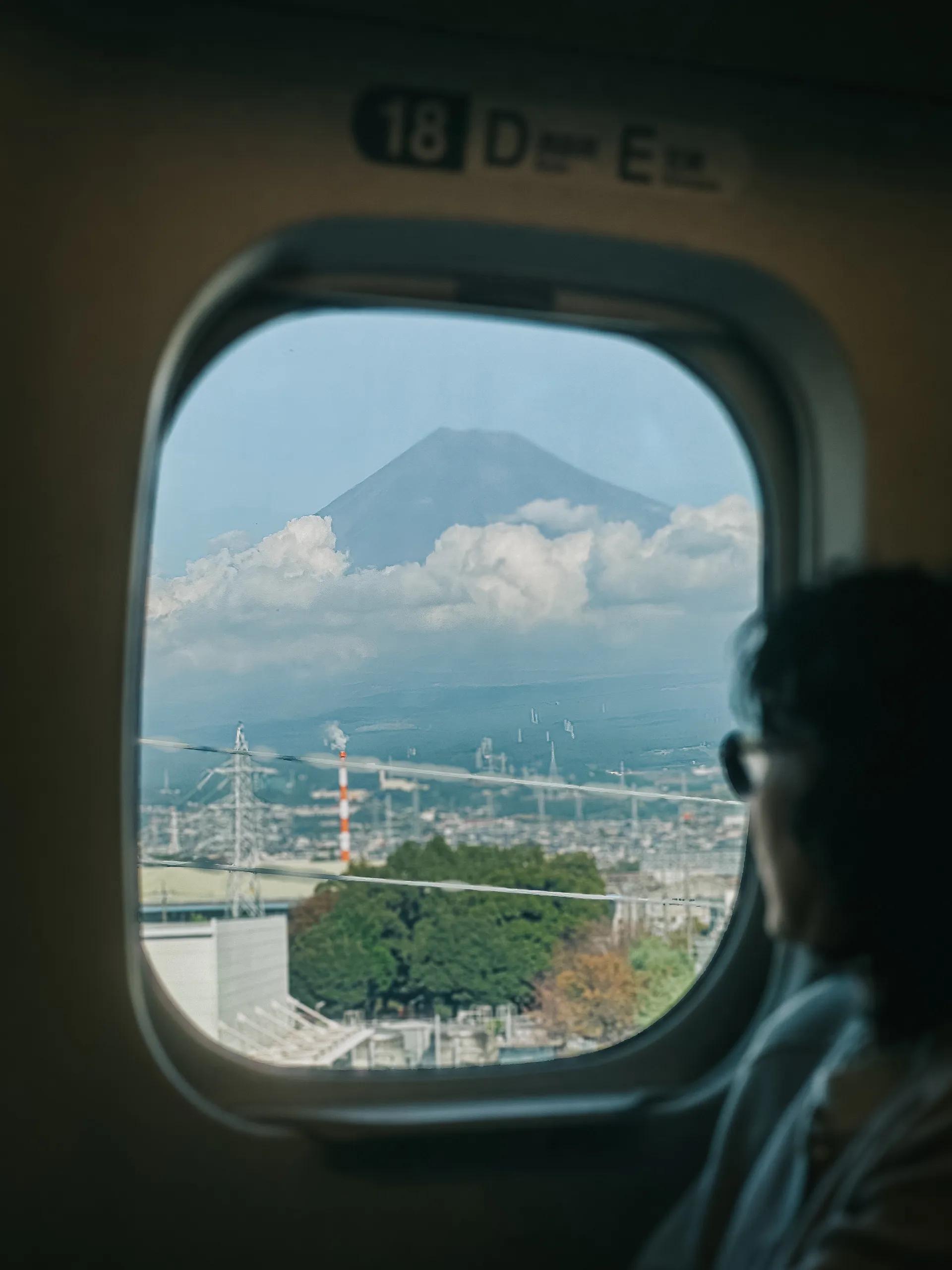
13 November, 11:16. The train races west. You have to sit on the right side: leaving Tokyo, Fuji appears on the right. For just a few minutes, it fills the window.
18 D · E
Above the window, the marker: row 18, seats D and E. Seats run from A to E; E, on the right-hand window, is the one everybody asks for at the ticket office on this route.
富士山 · 3 776 m
Fuji, 3,776 metres. In 2024 its snowcap arrived more than a month late: the first snow was only observed on 7 November, the latest date since records began in 1894. Six days later, the summit is still almost bare.
富士市 · Fuji-shi
In the foreground, the city of Fuji and its red-and-white striped chimneys. It is one of Japan’s paper capitals, built there for the abundant water flowing down from the mountain.
乗客 · jōkyaku
And on the right, against the light, a silhouette looking at the same thing I am. Shot on an iPhone, in one movement: some pictures won’t wait for you to get the right camera out.
かたつむり そろそろ登れ 富士の山
O snail,
Kobayashi Issa (1763–1828)
climb Mount Fuji,
but slowly, slowly!
Chapter 03 / 06
Osaka & Minoh 大阪 · Ōsaka
Osaka is nicknamed “Japan’s kitchen”: an old merchant city, it has always preferred a good meal to etiquette. Here they say kuidaore — eat until you drop.

A quiet alley, far from the neon of Dōtonbori. A white noren hangs in front of a slatted façade, calligraphed in black ink. When the curtain is out, the house is open; when it is taken in, it is closed. No other sign needed.
You part the fabric with one hand, lowering your head slightly. Without thinking about it, you are already bowing as you walk in.

Further on, a lit window: 神戸牛, Kobe beef — Kobe is only twenty minutes away by train. Behind the glass, a chef works the teppanyaki plate, alone in the orange light.
Real Kobe beef is a strict appellation: it must come from Tajima cattle born and raised in Hyōgo prefecture, and meet very precise marbling standards. Each certified animal gets a number, which good restaurants put on display.
North of Osaka, the hills of Minoh. Katsuō-ji is nicknamed “the temple of victory”: for centuries, warriors, exam candidates and athletes have come here to ask to win. You only need to step through the gate to see why it sticks in the memory.
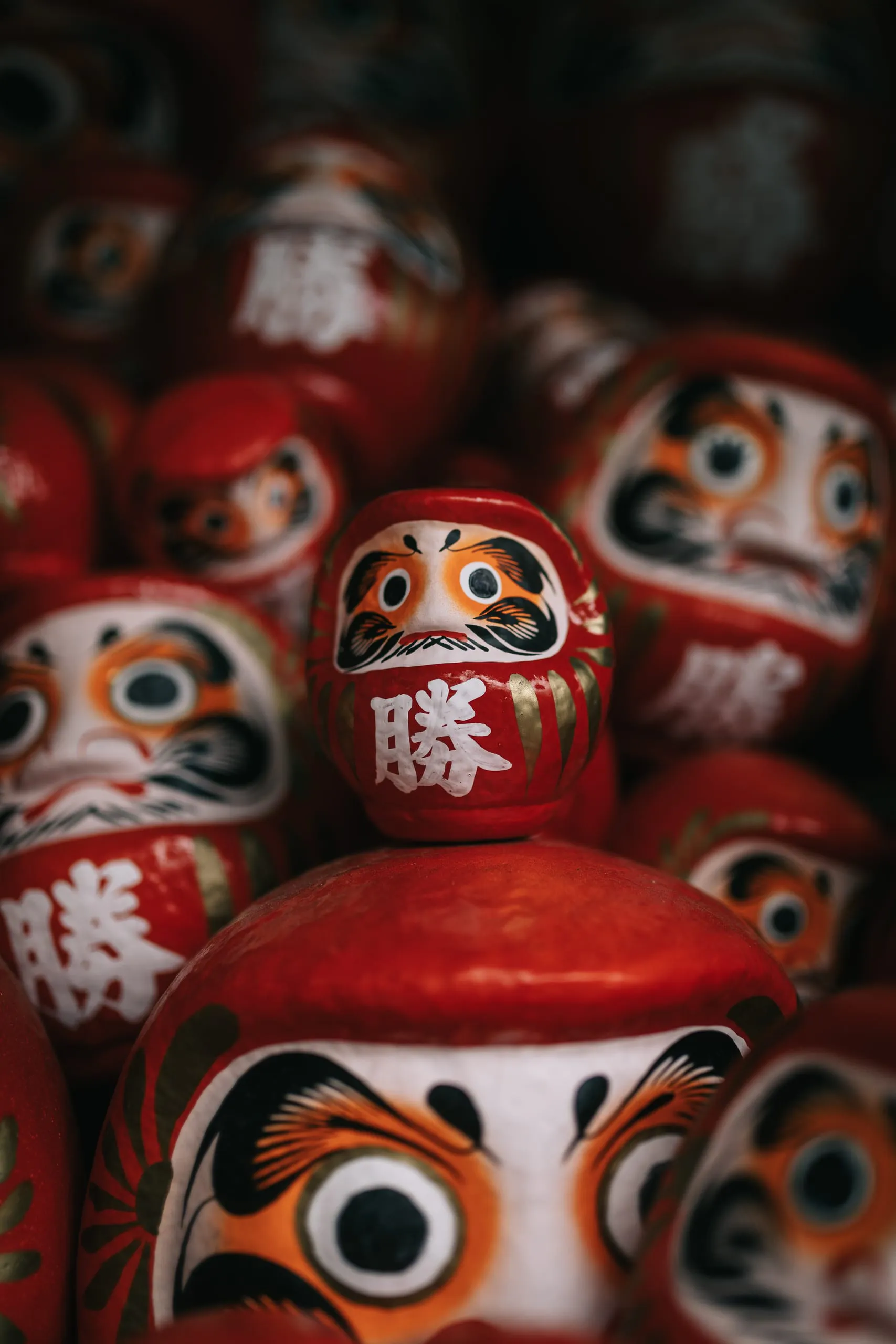
Hundreds of red daruma, packed together on low walls, steps and lantern roofs, all staring back at you. These round, weighted figures are modelled on Bodhidharma, the monk who founded Zen: legend says he meditated facing a wall for nine years, until he lost the use of his legs. Knock a daruma over and it always rights itself.
勝 · katsu
On their bellies, a single character: 勝, katsu, “to win”. The same one as on the izakaya sign in Asakusa, on the very first night. Here it is the temple’s own name, and everyone leaves with a daruma for a victory to come — an exam, a competition, an ordeal.
目 · me
Look at their eyes. A daruma is bought with blank eyes; you paint in one pupil while making a wish, and the second only once it comes true. These ones have both eyes: wishes fulfilled, brought back to the temple as thanks.
七転び八起き
A proverb always goes with the daruma: nana korobi ya oki — fall down seven times, get up eight. A good plan, for travelling as for everything else.
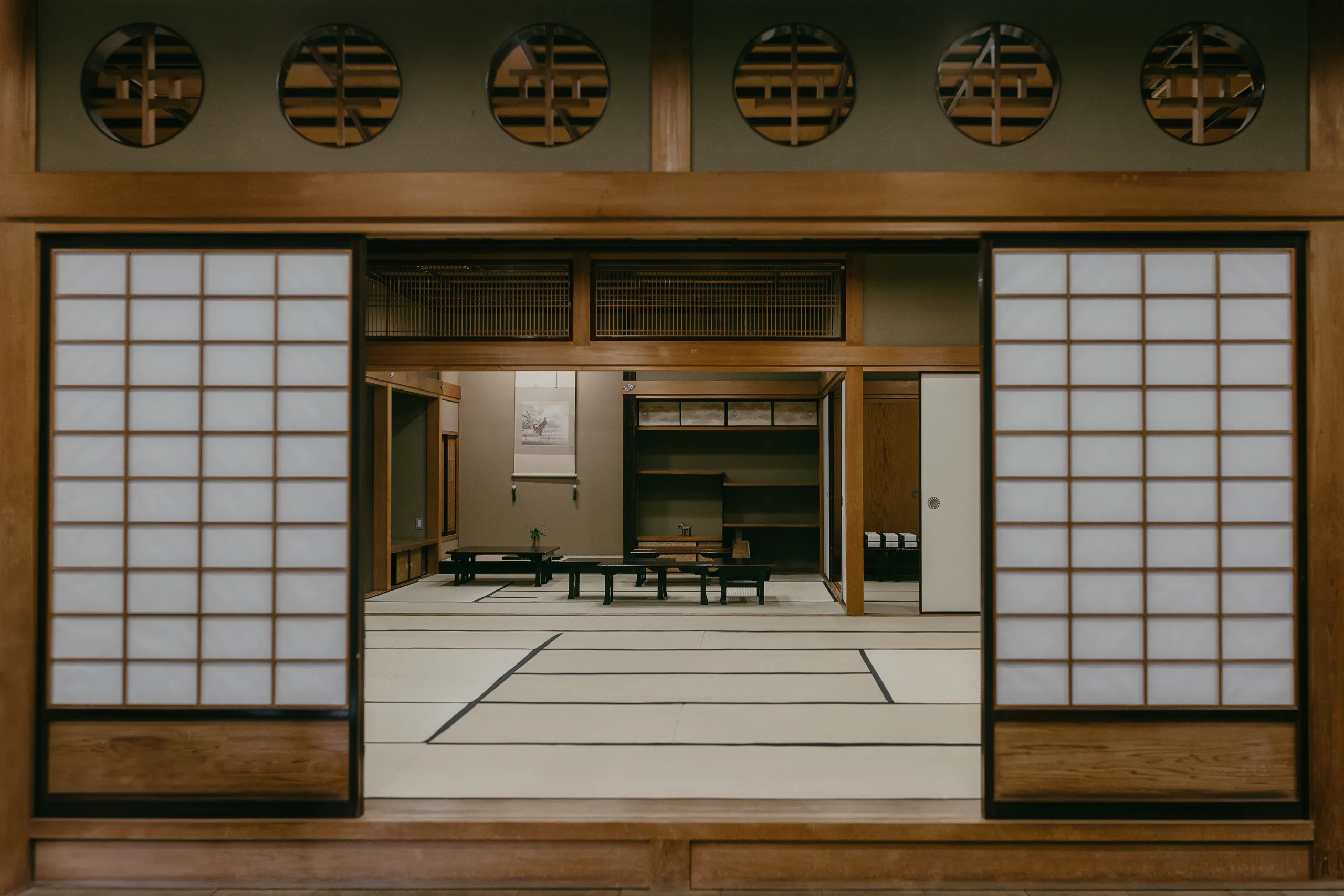
16 November, 15:36. An old residence, sliding doors drawn back: the eye passes through three rooms in a row. In the traditional Japanese house, partitions move, and space changes shape with the hour, the season or the number of guests.
欄間 · ranma
Above the doors, the ranma: openwork transoms that let air and light pass from room to room, even with the doors shut. Here, circles of cut wood, each with its own pattern.
障子 · shōji
The shōji: a light wooden lattice covered with washi paper. They don’t block the light, they diffuse it. The whole house is bathed in that milky glow, without a single hard shadow.
床の間 · tokonoma
At the far end, in the tokonoma alcove, a hanging scroll. It is the room’s place of honour: a calligraphy or painting is displayed there and changed with the seasons, and the most important guest sits with their back to it.
畳 · tatami
On the floor, the tatami mats. Their dark borders never meet in a cross: four corners coming together is said to bring bad luck. Room sizes are still counted in mats — six, eight, ten “jō”.

Outside, a tightly clipped hedge of deep green. Up close, they are tea bushes. It was in Kansai, in Uji, between Osaka and Kyoto, that green tea developed in the Middle Ages before spreading across the whole country.
At ƒ/1.4, the 35 mm keeps only a few leaves sharp in the foreground; the rest melts into a green matter, almost a texture.

17:01. In November the sun sets before 5 pm. On the platform of a small station, two people wait, one at each end of the bench.
The posters, the fluorescent tube, the yellow tactile paving along the edge — a Japanese invention from 1965, now found all over the world: everything is in its place, nothing moves. Stations like this tell everyday Japan better than any temple.
Chapter 04 / 06
Nara 奈良 · Nara
Japan’s first permanent capital, from 710 to 784. Its temples are older than anywhere else, and the deer wander among them as if they owned the place.

A street mirror by the side of a path. These convex mirrors are everywhere in Japan, at the blind corners of alleys too narrow to see cars coming.
This one reflects a long white wall, a temple roof with heavy curves — and the two of us, cameras in hand. An accidental self-portrait, slightly distorted, which suits it.

Chapter 05 / 06
Kyoto 京都 · Kyōto
Imperial capital for over a thousand years, from 794 to 1868. But Kyoto also reveals itself on foot, away from the temples, in streets where nothing is set up for visitors.
 Pl. 15 · 19.11.2024 · 12:38 · Canon 5D IV · 35 mm ƒ/1.4 Art · ƒ/2.8 · 1/4000 s · ISO 100
 Pl. 16 · 19.11.2024 · 13:18 · Canon 5D IV · 35 mm ƒ/1.4 Art · ƒ/1.4 · 1/500 s · ISO 100
19 November, on foot. 止まれ — tomare, “stop”: in Japan the stop sign is a red, downward-pointing triangle, which has also carried the English word STOP since 2017, ahead of the Tokyo Games. Forty minutes later, a yuzu tree bends under its fruit; this small, sour citrus scents hot baths on the evening of the winter solstice.
Chapter 06 / 06
Back to Tokyo 帰路 · Kiro
Kiro, “the way home”. Three last days in Tokyo, and one last light.


